How to store The Lord of the Rings LCG once you pass the core set
The card pool grows by cycle and the tokens never stop moving. How to sort encounter sets, player cards by sphere and the tokens a quest actually reaches for.
The Lord of the Rings LCG has a storage problem the core box hides well. Everything fits, right up until the first cycle arrives, and then it stops fitting all at once. Worse, the game asks you to find things in two completely different ways depending on whether you are building a deck or setting up a quest — and a single sorting scheme cannot serve both.
So use two.
Player cards belong to spheres, not to expansions
Nobody builds a deck by remembering which pack a card came in. You pick a sphere, or two, and browse what is available: Leadership, Lore, Spirit, Tactics, then neutral.
That is the order the cards want to be in, and it is the reason the tidy approach — one box per cycle, in release order — makes deckbuilding slowly miserable. A Spirit deck wants every Spirit card in one place. Split across six lids, you build from the cards you remember rather than the cards you own.
Heroes are worth separating from allies and attachments, because a deck starts with heroes and then everything else follows from them. Within a sphere, hero first, then allies, attachments and events.
Encounter cards belong to their quest, and nothing else
Encounter cards are the opposite case. You will never browse them. You will look up exactly one thing: the encounter sets a quest names in its setup, and then the quest deck itself.
So keep each quest whole — its quest cards and its encounter sets together, labelled with the quest name — and never sort encounter cards by type. Sorting them by type is how a fifteen-minute setup happens.
The one nuance: some encounter sets are shared between quests in the same cycle. Keep those together in their own divider, under the set name, and note on the quest divider which shared sets it needs. It sounds fussy and it is the difference between reading a list and hunting.
Sleeves, and the arithmetic nobody does first
The core box was sized for bare cards. Sleeve the collection and it takes about half again the space; double-sleeve it and stop expecting any factory insert to close.
This matters more here than in most card games because the encounter side of the pool is large and permanent — you sleeve it once and it stays sleeved for years. Measure a sleeved stack before you buy a box, not after.
For most collections past two cycles, the honest answer is a long card box with dividers and no insert at all.
The tokens are the part that stays on the table
Cards get sorted once a month. Tokens get handled every round, and this is where the game quietly costs you attention.
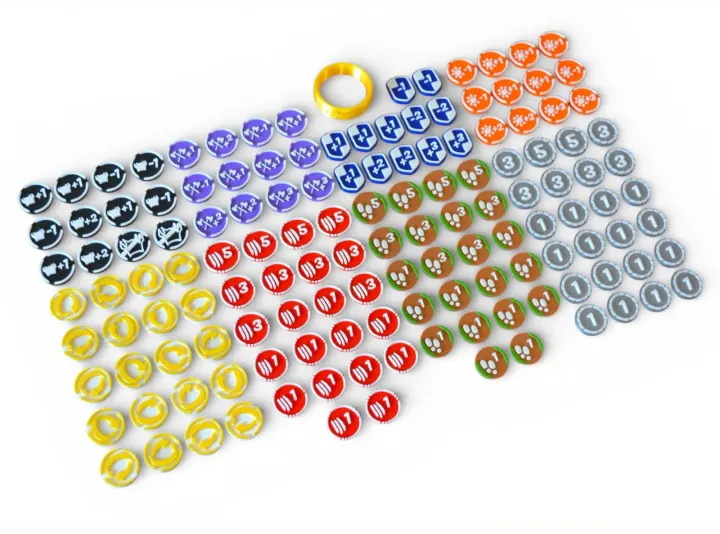
The core set tracks a lot of quantities with cardboard that looks alike at arm’s length: resources, progress, damage, defence, attack, power, and threat sitting on cards. In practice, three habits fix most of it.
Give each quantity its own container, not its own corner of the lid. Loose piles migrate, and migrated piles become a disagreement about the board state halfway through a quest.
Use values, not counts, for anything that grows. Resources are the clearest case: a hero sitting on nine resources is a pile deep enough to hide the card it is on. Tokens marked with values turn that into a short stack you read rather than count, and the same is true of progress on a long quest card.
Tell the roles apart by shape. Defence, attack and power are the three that get confused, because they are the three that are conceptually similar and physically identical. A shield reads as defence without anyone checking.
Threat is the exception worth being clear about: your own threat lives on the dial that came in the box, and no amount of tokens improves on it. Tokens are for threat placed on enemies and locations.
Tear down by quest, not by tidiness
Put the encounter sets back behind their quest divider before you put the player cards away, because the player cards are the ones you will touch again first anyway.
The collection that stays playable at four cycles is not the one with the neatest shelf. It is the one where setup is reading a list.