How to store Arkham Horror LCG, from the Revised Core to your third cycle
The card pool outgrows the box long before you expect it to. How to sort encounter sets, player cards and tokens so a campaign night starts with finding things rather than rebuilding them.
Every Arkham Horror collection reaches the same evening. You sit down to start a scenario, the setup instructions name six encounter sets, and finding them takes longer than playing the first turn. The box is full, everything is technically in it, and none of it is where you can reach.
This is not a shelf-space problem. It is a sorting problem, and the game itself tells you how to solve it — most people just sort by the wrong thing first.
Sort encounter cards by set, never by type
This is the one decision that matters more than every other decision here.
Each encounter card carries a small icon and a set name: Ghouls, Striking Fear, Ancient Evils. Scenario setup instructions are written in exactly that vocabulary — gather these sets, shuffle them together. So a collection sorted by encounter set is a collection where setup is a lookup, and a collection sorted by card type — treacheries here, enemies there — is one where every setup is a search.
Sorting by type feels tidier. It is the single most common way an Arkham collection becomes slow to use.
Keep each set together, in set-name order, and setup stops being work. The same logic applies to the scenario cards themselves: acts, agendas and locations belong with their scenario, not in a pile of acts.
Player cards: by class, then by level
Player cards get used the opposite way. Nobody builds a deck by asking for a specific card; they browse a class looking for options at a price they can afford. So the useful order is class first — Guardian, Seeker, Rogue, Mystic, Survivor, then neutral — and within each class, level order.
Level matters because deckbuilding is a budget exercise. When the upgrade sheet says you have five experience to spend, you want to look at what five buys, not read every Guardian card in the pool.
Signature cards and weaknesses are the exception worth pulling out: they belong with their investigator, because they are never a choice.
The boxes, honestly
The Revised Core box holds the Revised Core comfortably and one deluxe expansion uncomfortably. It was not designed to hold a growing pool, and no amount of clever packing changes that.
Once you pass the core plus a cycle, the realistic options are a long card box with dividers, or one box per cycle. One box per cycle looks neater on the shelf and is worse to use, because cross-cycle player cards are the ones you actually browse — a Mystic building a deck wants every Mystic card in one place, not spread across three lids.
A single long box with encounter sets at one end and player cards by class at the other is the arrangement that most collections settle into eventually. It is worth going there directly.
Two things people underestimate. Sleeves change the arithmetic completely: double-sleeved cards take roughly half again the space, and every stock insert is sized for bare cards. Measure with sleeves on before buying anything. Return-to boxes are also campaign boxes — they are designed to hold their whole campaign, replaced encounter sets included, and using them that way solves the storage problem for that campaign entirely.
Dividers do more than they look like they should
A divider per encounter set and per class turns a box you rummage in into a box you reach into. Printed tabs beat handwritten ones for one unglamorous reason: you read them at a glance from above, at an angle, in the light of a dining room, and handwriting fails that test long before printed text does.
If you write your own, write the set name and nothing else. The icon is not what you scan for.
Tokens are a different problem from cards
Cards want sorting. Tokens want containers, and they want them for a reason that has nothing to do with tidiness: loose tokens in a box lid become a disagreement about the game state.
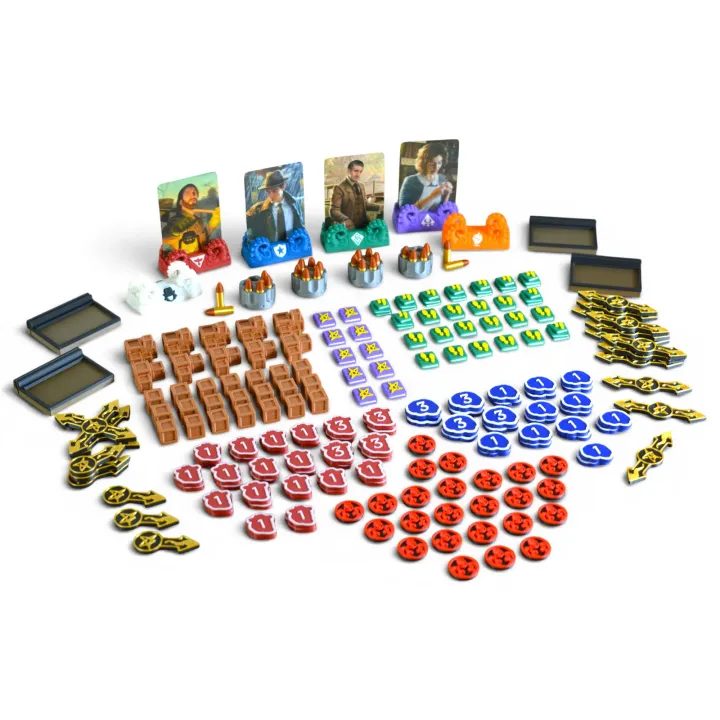
Three that repay a container each:
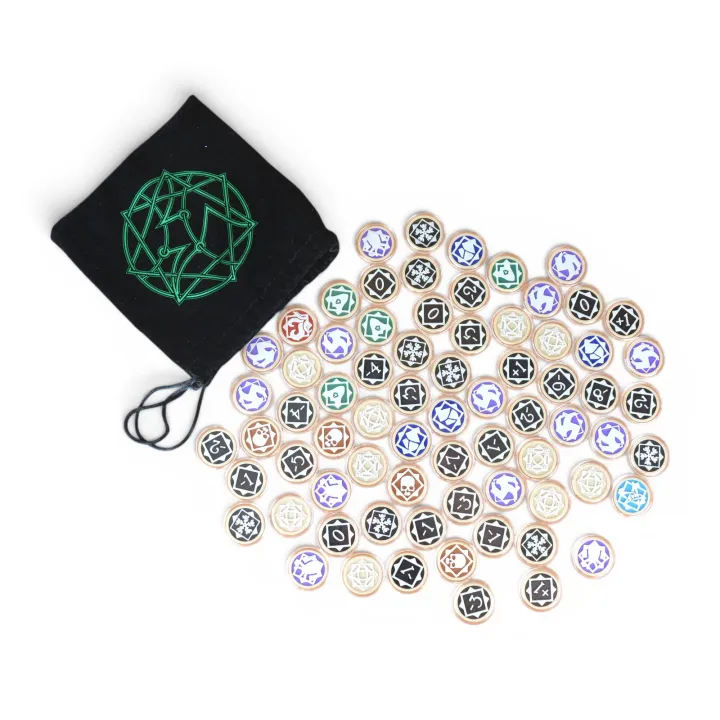
The chaos bag. It stays a bag — that is the point — but what goes in it matters. Tokens you can tell apart by touch remove a step from every skill test, and Arkham is made of skill tests.
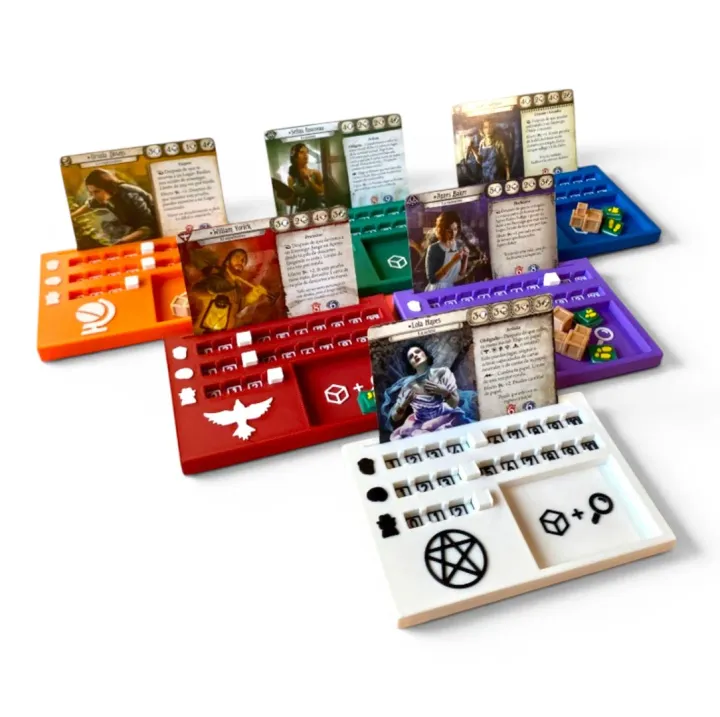
Damage and horror. These get knocked, and once knocked, two players remember different numbers. Anything physically hard to change by accident solves it, which is why trackers and dials are worth more here than anywhere else in the game.
Clues and resources. These move constantly between the pool and player areas, so they want a container each with an open top, not a bag you reach into.
The rest — doom, horror markers you never run out of, the odd scenario token — can live loose without anyone minding.
The part that actually saves time
Tear down in the order you will set up. Encounter sets back to their divider, scenario cards back to their scenario, player cards to their class.
Ten minutes at the end of a session buys back twenty at the start of the next one, and the collection stays usable at the size where most collections stop being usable.