Keeping a Spirit Island board readable with four players
Spirit Island buries its board under pieces by turn three. How to keep presence, invaders and blight distinguishable when four spirits share an island.
Spirit Island is a co-operative game whose central skill is reading the board accurately. Every plan depends on knowing exactly what is in each land: how many explorers, whether that town is a town or a city, whose presence is where, and how close the blight is to cascading.
By turn three of a four-player game, a single land can hold nine or ten distinct pieces. The information is all there. It is just not legible.
The failure is silhouette, not colour
The instinct is to fix legibility with colour, and colour is the first thing to fail. The board is already printed in greens and browns, the lighting over most tables is not great, and roughly one player in twelve has some degree of colour vision deficiency.
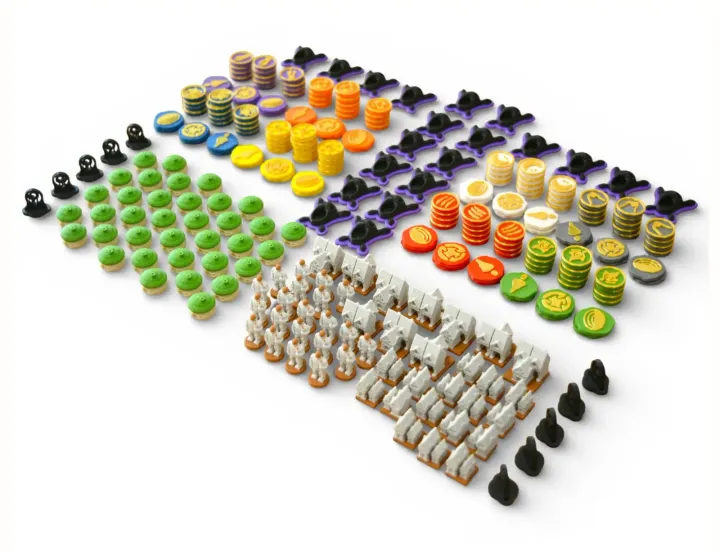
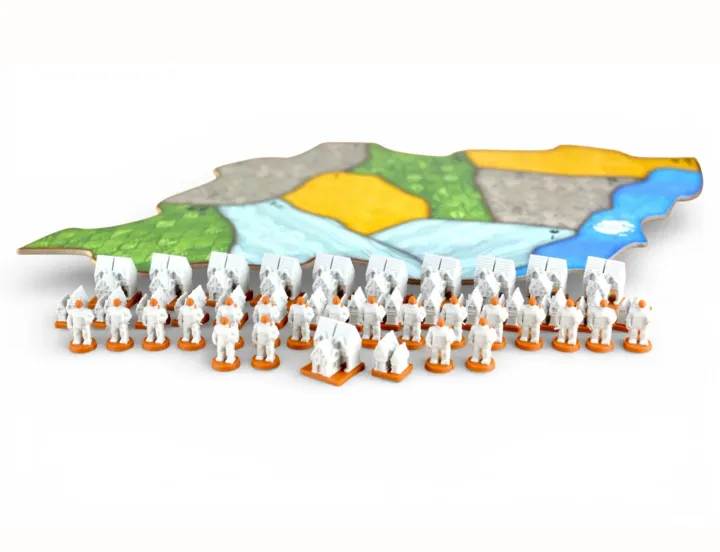
Height and shape survive all of that. If explorers, towns and cities are three obviously different sizes, you can count a land from across the table without leaning in — and more importantly, you can count it wrong far less often.
This is why invader piece upgrades are the single highest-value change for Spirit Island specifically. The game asks you to count invaders more often than it asks you to do anything else.
Presence needs to be identifiable per spirit, not per player
In a two-player game, colour is enough: my presence is red, yours is blue. In a four-player game with spirits that share territory heavily, you are constantly resolving “whose presence is in this land, and how many”.
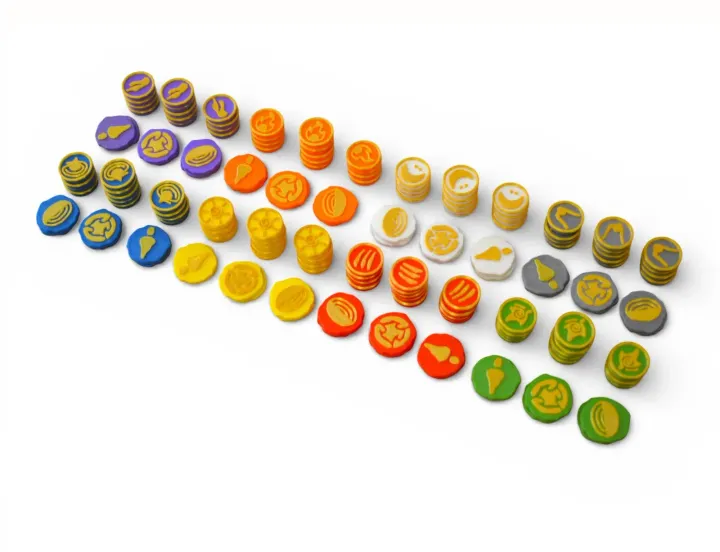
Distinct shapes per spirit make that a glance instead of a count. It also matters for effects that care about a specific spirit’s presence, which are the effects players most often resolve incorrectly.
Blight should read as damage, not as another invader
Blight is not an invader, but it sits in the same lands and, in the published components, has a similar visual weight. New players routinely treat a blighted land as more dangerous than it is, or miss that it is one blight away from cascading.
Blight that sits low and dark reads as ground damage rather than as a piece in play. That is the correct mental model and the components should carry it.
Fear and the invader deck are a separate zone
Keep the fear pool, the fear deck and the invader deck off the island. Anything that is not a land’s contents should be physically outside the board’s edge, because the moment supply piles encroach on the island, counting a coastal land becomes ambiguous.
Give the invader deck its own space with the three stage cards visible. The question “what stage are we in” gets asked every round.
The ravage and build check
The most common rules error in Spirit Island is resolving ravage or build in a land the group has miscounted. It is not a rules misunderstanding — everyone knows what ravage does. It is a reading error.
Adopt the habit of pointing at each affected land and saying the count out loud before resolving. It costs ten seconds a round and catches most of them.
What to change first, if you change anything
If you upgrade one thing for Spirit Island, upgrade the invaders. Explorers, towns and cities are the pieces you count most, the pieces that most often get miscounted, and the pieces whose miscount most often loses the game.
Presence markers are the second change, and they matter in proportion to how many players you usually have. At two players they are a nicety. At four they are the difference between reading the island and reconstructing it.