How to lay out an Arkham Horror LCG table so four players can read it
Arkham Horror: The Card Game sprawls. A layout that keeps the act, agenda and every investigator's play area readable from any seat, and the habits that keep it that way.
Arkham Horror: The Card Game does not have a board. It has an agreement about where things go, and that agreement collapses somewhere in the second act of a four-player game. The cards are still on the table; nobody can read them.
This is a layout problem rather than a rules problem, and it is worth solving once.
Put the scenario’s spine in the middle
The act and agenda cards drive the whole scenario. They tell you what you are racing towards and what is racing towards you, and they are the two cards players forget to check.
Lay them along the centre of the table, perpendicular to the seating, so that neither end of the table has them upside down. Keep doom on the agenda visibly separate from clues on the act — they are the two counters most often confused in a hurry, and putting them on opposite sides of the centre line prevents most of it.
If your table is long, this is where a stand earns its keep: an upright act and agenda can be read from four seats, a flat one from two.
Give every investigator a fixed footprint
The single biggest source of sprawl is that each player’s area grows in whatever direction there is room. Two hours in, one player’s assets have crossed the centre line and another’s are in their lap.
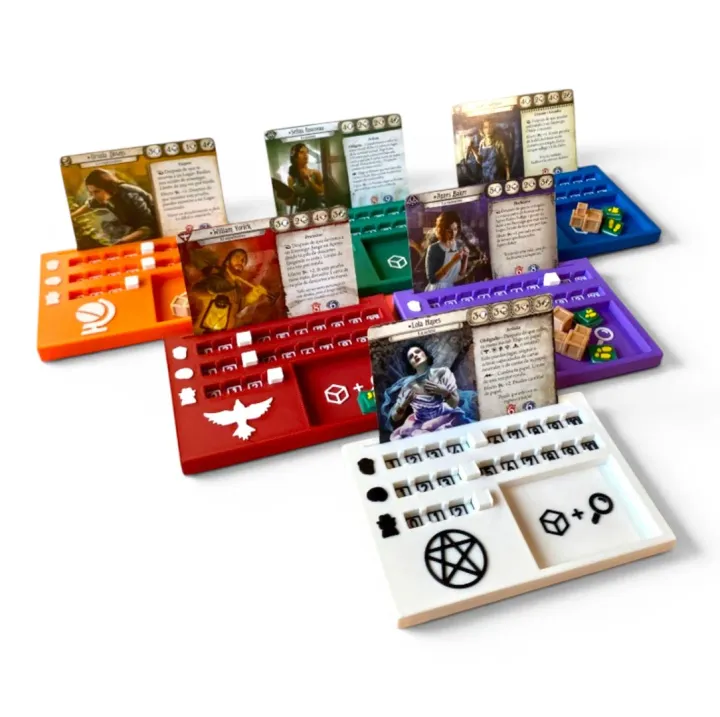
Agree a footprint at setup: investigator card, assets in a row beneath it, resources in one place, damage and horror on the card itself. The point is not which arrangement you choose — it is that all four players use the same one, so anyone can read anyone else’s board without asking.
This is also why raised investigator boards work. They physically enforce the footprint, which is a more reliable mechanism than four people remembering an agreement.
The location row is the map
Locations connect, and the connection matters more than the arrangement looks like it should. Build the map outward from the starting location in the direction the connections actually run, rather than in a neat grid, and leave a finger’s width between locations so clues and enemies sitting at a location are unambiguously at it.
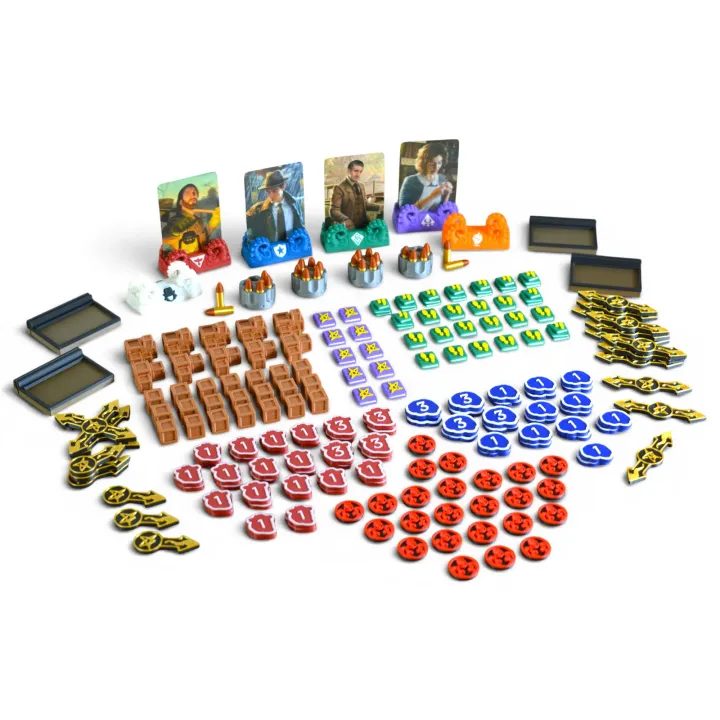
When a scenario introduces directional connections, mark them. Arrow tokens do this without adding text to the table, which matters because a location already carries a name, a shroud value and a clue count.
Damage and horror: use something that cannot drift
Loose tokens on a card are fine until somebody knocks the table, and then they are a disagreement. Two players will remember different numbers and neither will be sure.
A dial or tracker fixes this by being physically hard to change by accident. It also makes the number readable from across the table, which speeds up the constant question of whether an investigator can survive another attack.
If you are using tokens, at least keep damage and horror on opposite corners of the card. Mixed piles are the ones that go wrong.
The chaos bag is a touch problem
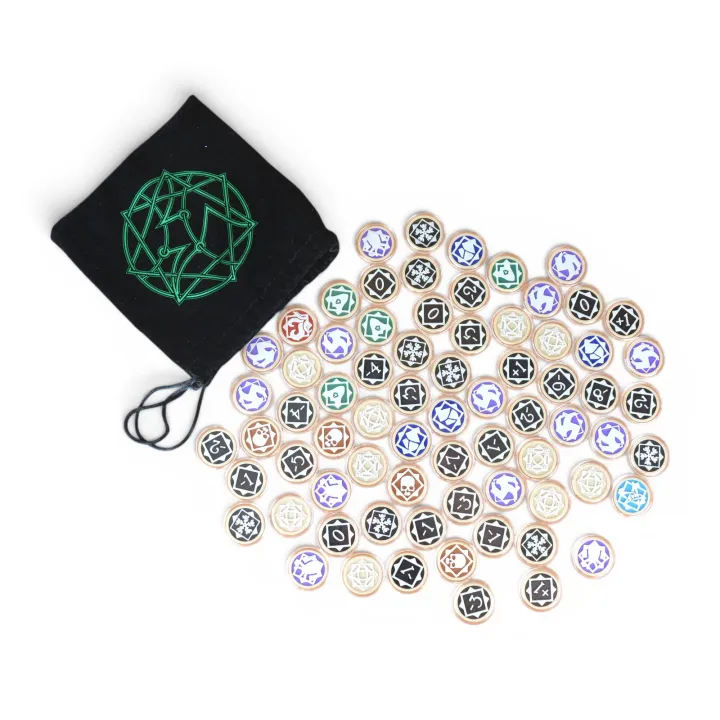
Drawing from the bag is the one moment where the game asks you to not look at what you are doing. Standard tokens are thin and similar, so most players end up pulling a token out, squinting at it, and passing it round.
Tokens you can tell apart by touch remove a step from every skill test in the game, and there are a lot of skill tests. Deep moulding matters more than colour here, because the whole point is that your hand is in an opaque bag.
Tear down in the order you will set up
Arkham punishes disorganised storage more than most games because the card pool grows. Sort by encounter set, not by type, and keep the scenario’s cards together — the next session starts by finding one set rather than rebuilding it from a shuffled pile.
Ten minutes at the end of a session buys back twenty at the start of the next.